

Generative AI is fundamentally transforming how users interact with mobile apps, blending creativity, personalization, and automation into everyday experiences.
The surge in Gen AI and Mobile App Experience has propelled app downloads to 1.7 billion in the first half of 2025, nearly doubling from late 2024, per a report from Sensor Tower. Consumer spending has followed suit, with generative AI apps earning almost USD 1.1 billion in 2024—a 200% year-over-year increase.
As this technology scales, mobile developers are racing to integrate intelligent features that redefine design, user engagement, and performance.
Overview of Generative AI in the Mobile App Industry
Generative AI is reshaping the mobile app landscape through systems capable of producing text, visuals, designs, and predictive outputs that align with user needs. Its influence covers everyday consumer apps and enterprise-grade platforms, creating products that feel more adaptive and context-aware.
The technology helps developers work with cleaner workflows. It supports teams that want reliable ways to extend app features without bloated development cycles. This shift promotes a more scalable environment where performance, accuracy, and usability sit at the center of overall product improvement.
Impact of Generative AI in the Mobile App Industry
Generative AI is influencing multiple industries by reshaping how mobile apps support decision-making, automation, and user engagement
1. Finance
Financial apps now use generative AI models to deliver clearer forecasting tools, quick risk evaluations, and more intuitive digital advice. These systems help users understand spending habits and create projections that support better decision-making. Developers also utilize generative tools to detect suspicious behavior more quickly, refining fraud-response systems and providing enhanced protection for customers.
2. Manufacturing
Production-focused apps are gaining momentum, with generative AI guiding planning workflows, creating maintenance insights, and enhancing workforce coordination. The technology helps teams predict equipment strain, shape more practical schedules, and support employees with reliable on-site instructions. This makes mobile solutions more valuable as everyday operational tools.
3. Healthcare
Medical applications utilize generative models to organize clinical notes, summarize patient data, and provide clearer diagnostic support. These systems streamline tasks that usually consume attention, allowing professionals to focus on direct patient care. Mobile platforms enriched with these capabilities promote consistency while reducing friction in fast-moving healthcare settings.
4. Entertainment
Content apps benefit from generative AI through faster production cycles, personalized story flows, smart audio creation, and dynamic artwork. This provides users with content that feels aligned with their personal taste, while also giving creators new ways to scale their output. The result of gen AI app innovation is a stronger and more engaging digital experience.
5. Gaming
Generative AI enhances mobile gaming with adaptable storylines, real-time scene creation, character variations, and smarter NPC behavior. These upgrades help developers craft games that feel more reactive, fresh, and satisfying. Users often stay longer when game environments adapt in ways that align with their actions and play patterns.
Benefits of Generative AI in Mobile Apps
Generative AI offers a wide range of practical advantages, enabling teams to work faster, refine ideas, and deliver apps that are more responsive to user needs.
1. Boosted Creativity
Generative systems help teams produce concepts, visuals, and written content without slowing down the development cycle. Gen AI driven mobile apps help designers and writers explore multiple ideas quickly, giving mobile apps richer features and more intentional creative direction.
2. Personalized User Experience
Apps can adapt layouts, suggestions, and interactions to match users’ preferences in real-time. Gen AI user personalization strengthens user connection and encourages consistent engagement. The experience becomes smoother and more aligned with personal habits.
3. Automating Repetitive Tasks
Routine work—such as tagging data, drafting copy, or preparing layouts—can be handled by generative tools. This frees developers and product teams to focus on more strategic tasks. The boost in productivity supports stronger release cycles and improved product quality.
4. Enhanced Speed and Efficiency
Development pipelines operate with fewer bottlenecks when generative AI supports ideation, testing, and refinement. Mobile teams complete tasks sooner and deliver updates at a steadier pace, which keeps apps more competitive.
Use Cases of Generative AI in Mobile Apps
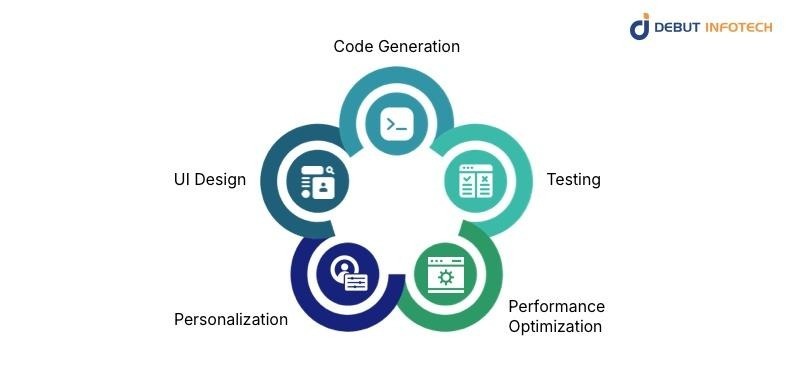
Generative AI supports a growing list of real-world functions that help developers build smarter, faster, and more adaptable mobile applications. Here are some Gen AI use cases in apps:
1. Code Generation
Generative AI accelerates development by producing structured code snippets, refining logic, and offering context-aware suggestions that reduce errors. Developers or generative AI development companies can request functions, data models, or API handling blocks and receive solutions that align with project requirements. Generative AI application development shortens build time, lowers debugging pressure, and supports teams working on large applications that need consistent quality across multiple components.
2. UI Design
AI-driven design tools create interface concepts, color systems, layout variations, and component structures based on short prompts. Designers can adjust these outputs to align with the brand’s direction while avoiding repetitive drafting work. The technology helps teams explore fresh ideas, validate user flows earlier, and maintain visual consistency. This results in interfaces that feel intentional, polished, and easier for users to navigate.
3. Testing
Generative AI in mobile technology produces detailed test scenarios that simulate real user behavior, edge cases, and stress conditions. It highlights vulnerabilities in workflows, identifies unpredictable response patterns, and predicts where failures might appear in future releases. This reduces manual testing load and improves reliability. Teams can release updates with greater confidence, knowing that the app has been thoroughly assessed through broader and more realistic evaluation layers.
4. Personalization
Personalization systems powered by generative AI study user habits, touchpoints, preferences, and contextual signals to shape individual experiences. They adjust recommendations, refine layouts, craft predictive content, and modify interaction flows. This helps apps feel more natural and responsive to each user’s rhythm.
The Gen AI customer experience becomes smoother, engagement increases, and retention improves, as users feel the app evolves alongside their behavior.
5. Performance Optimization
Generative AI analyzes mobile activity logs, system usage, resource allocation, and interface behavior to propose fixes that enhance speed and stability. Gen AI mobile solutions identify outdated components, inefficient backend calls, and design elements that slow down the rendering process.
The system then suggests optimized structures that lighten the load. This encourages developers to produce smoother builds, achieve stronger performance, and deliver a more dependable user experience across devices.
Examples of Generative AI in Mobile Apps
Several major tech companies are already utilizing generative AI to enhance features, streamline tasks, and improve user interaction.
1. Apple AI
Apple integrates generative AI into features such as text rewriting, advanced image editing, and device-level intelligence that adapts to user behavior. These tools help users complete tasks more efficiently while keeping all data processed securely on the device.
Developers also benefit from improved APIs that support smoother interactions, stronger personalization, and more consistent performance across Apple’s mobile ecosystem.
2. Google Play Instant
Google Play Instant uses AI to streamline how users experience apps before installation. It analyzes behavior, trims unnecessary loading steps, and allows lightweight previews without compromising functionality.
Developers use these insights to refine onboarding, optimize content delivery, and remove friction points. The result is a more efficient introduction process that enables users to make decisions faster and enhances overall engagement.
3. Facebook AI
Facebook applies generative AI to enhance content recommendations, foster safer community interactions, and support creative tools within its mobile apps.
The system analyzes patterns, detects harmful content, and adapts feeds to individual interests with improved accuracy. It also powers text and image generation tools that help users express themselves, making the platform smoother and more responsive to shifting user needs.
Challenges of Generative AI in Mobile Apps
Generative AI introduces a set of challenges that developers or generative AI consultants must handle carefully to maintain trust, quality, and fairness.
1. Ethical Concerns and Transparency
Generative AI raises questions about how user data is processed, which decisions are automated, and whether outputs can be explained clearly.
Mobile apps must demonstrate to users how these systems work and establish boundaries that ensure respectful, safe, and predictable interactions across various use cases.
2. Quality and Consistency
Model outputs can vary depending on the context, training data, or complexity of the prompt. This creates unpredictable responses that may weaken user trust.
Developers need validation layers, stronger monitoring, and fallback rules to maintain stable results, especially in apps where accuracy directly impacts user decisions.
3. Technical Limitations
Large models demand processing power that many mobile devices can’t support smoothly. Developers rely on cloud execution, model compression, and edge optimization to strike a balance between performance and battery usage. Even with these techniques, certain complex tasks can still push devices beyond comfortable operating levels.
4. Data Availability and Bias
Generative systems rely on robust datasets, and gaps in that data can lead to biased or incomplete results. This affects recommendations, content generation, and decision logic. Teams must build balanced datasets and apply frequent checks to reduce unintended skew and create fair, reliable app behavior.
Conclusion
Generative AI is shifting mobile development toward faster, smarter, and more adaptive digital experiences. Its influence spans design, automation, testing, and personalization, giving developers stronger tools while improving how users interact with everyday apps.
As capabilities grow, the connection between Gen AI and Mobile App Experience will continue shaping how products evolve and how teams deliver features that feel more intuitive and reliable.
Debut Infotech helps businesses build powerful Gen AI–driven mobile apps that feel refined, intuitive, and fully aligned with modern user behavior. As a top-tier generative AI development company, our team blends technical depth with practical design to deliver apps that adapt, automate, and perform consistently across devices.
From concept to deployment, we support organizations that seek reliable AI features, streamlined workflows, and enhanced engagement.
